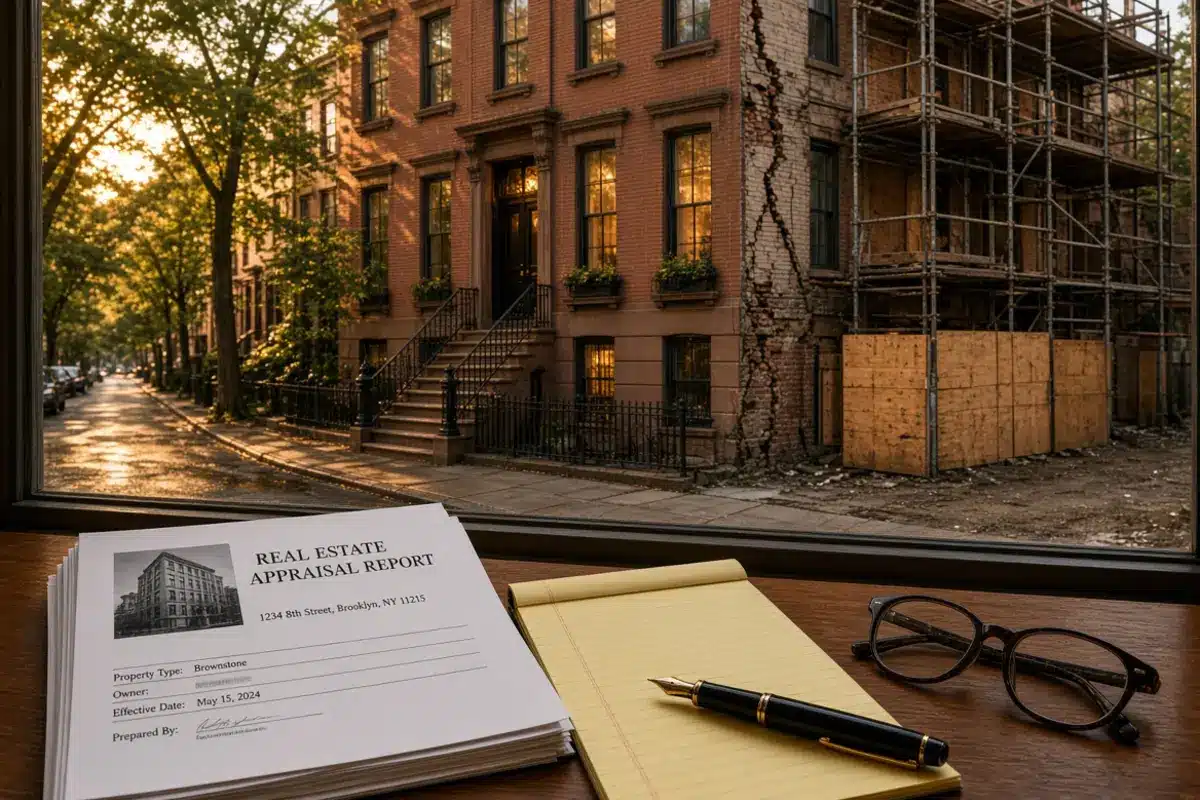

A date of death appraisal sets what a property was worth on the day the owner died. The alternate valuation date sets what it was worth six months later. Most New York estates only ever need the first one. The second is an option a small number of taxable estates can elect, and only when it actually lowers the tax bill.
A date of death appraisal is a retrospective real estate valuation that reports a property’s fair market value as of the exact date its owner passed away. Estates use it for probate, for filing estate tax returns, and to set the stepped-up cost basis that heirs inherit under federal tax law.
We handle these valuations across Manhattan, Brooklyn, and Staten Island, and the same two questions come up every time: which date applies, and do I even need an appraisal if nobody plans to sell? This guide answers both, with the New York rules that national articles leave out.

What is a date of death appraisal?
A date of death appraisal is a property valuation pinned to one specific day, the day the owner died. An appraiser looks back and works out what the home, condo, co-op, or brownstone would have sold for on that date, using sales and market conditions from that period, not today’s.
That backward-looking part is what makes it tricky. A standard appraisal values a property as of today, when comparable sales are fresh. A date of death appraisal might be ordered two years after the fact, so the appraiser has to pull sales that closed around the date of death and judge the market as it stood then. The Appraisal Institute’s standards are blunt about this: the value has to reflect the market on the effective date, not hindsight.
Estates lean on this report for a handful of jobs:
- Probate and estate filings
- Federal or New York estate tax returns
- Setting the heirs’ stepped-up cost basis
- Splitting assets fairly when there’s more than one heir
- Moving title into a trust or a beneficiary’s name
In practice, a date of death appraisal is one of several estate appraisal assignments an appraiser handles after a death, alongside work for trusts, litigation, and divorce. If you’re sorting out an estate in the five boroughs, the date of death appraisal is the core of what that work covers.
What goes into a date of death appraisal in NYC?
Price tracks scope, and scope depends on the property. A standard condo or one-to-four family home is straightforward. Co-ops, brownstones, and multi-unit buildings take more work, since the appraiser weighs the building’s finances or income alongside the unit itself. The bigger driver is how far back the date of death sits. A recent date means fresh records, while a date several years ago means digging for sales that closed back then and reading the market as it stood, which is slower and more involved.
I’ll say it plainly. A defensible appraisal is a small line item next to the capital gains or estate tax it can keep off an heir’s plate later. People who skip it to save money usually pay more in the end.
What is the alternate valuation date?
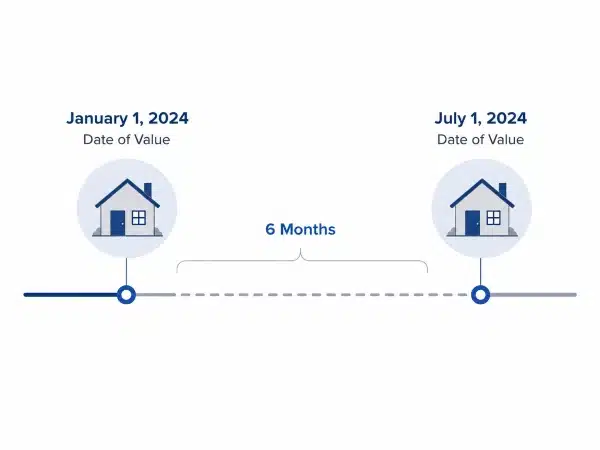
The alternate valuation date, or AVD, is a second valuation date set exactly six months after the date of death. It exists for one reason: to let a taxable estate report lower values if the market dropped during those six months.
The rules come from Section 2032 of the tax code, and they’re stricter than most people expect. An estate can only elect the alternate date if it reduces both the value of the gross estate and the estate tax owed. The election is irrevocable once made on the federal estate tax return, Form 706. And it applies to every asset in the estate, not just the real estate.
There’s a catch most people miss. You can’t take the alternate value for the house and keep the date of death value for everything else. It’s all or nothing across the whole estate. One more wrinkle: if a property is sold or distributed within that six-month window, it gets valued as of the sale date, not the six-month mark.
Do you need one valuation date or both?
Most estates need one date: the date of death. You’d only weigh both dates if the estate is large enough to owe estate tax and values fell after the death.
National articles treat this like a coin flip. It isn’t. The federal exemption is $15 million per person in 2026, so almost no estate owes federal estate tax at all. And the alternate date only helps when prices fall. In New York City, they didn’t. Nationally, prices barely moved, up 1.8% over the year per the FHFA. New York went the other way. The Case-Shiller index had the New York metro up about 5.1% for 2025, leading every major U.S. market while the national index crawled up just 1.3%, its weakest year since 2011. If a property is worth more six months after death, electing the alternate date would raise the tax, which defeats the whole point.
Date of death value vs. alternate valuation date
| Feature | Date of death (DOD) value | Alternate valuation date (AVD) |
|---|---|---|
| Effective date | The exact date the owner died | Six months after death, or the sale date if the property is disposed of within those six months |
| Who uses it | Nearly every estate, for probate and to set the heirs’ basis | Only estates that file Form 706 and only when it lowers the tax |
| Election rule | Default. No election needed | Must reduce both the gross estate and the tax. Irrevocable, and applies to all assets at once |
| Best when | Values rose or held steady after death, which is the usual NYC case | Values dropped in the six months after death |
| Effect on heirs | Stepped-up basis equals the date of death value | Basis equals the lower AVD value, which can mean more capital gains tax later |
| NYC reality, 2025 to 2026 | Prices up about 5%, so this is usually the figure that matters | Rarely helps in a rising market like New York City |
So for the typical Brooklyn or Manhattan estate, the date of death value is the number that does the work. The alternate date is a tool for falling markets, and NYC hasn’t been one lately. Any certified New York appraisal firm will tell you the same thing.

When do you actually need an appraisal?
You need a date of death appraisal if the estate is going through probate, if it might owe federal or New York estate tax, or if heirs need a defensible value to split assets or document their basis.
In plain terms, get one when:
- The estate is entering probate
- It might owe federal or New York estate tax
- An estate attorney or CPA asks for a valuation
- Several heirs need a fair, documented way to divide assets
- Someone plans to sell and needs the stepped-up basis on record
- The estate is filing federal Form 706 or New York Form ET-706
Where the New York estate tax cliff comes in
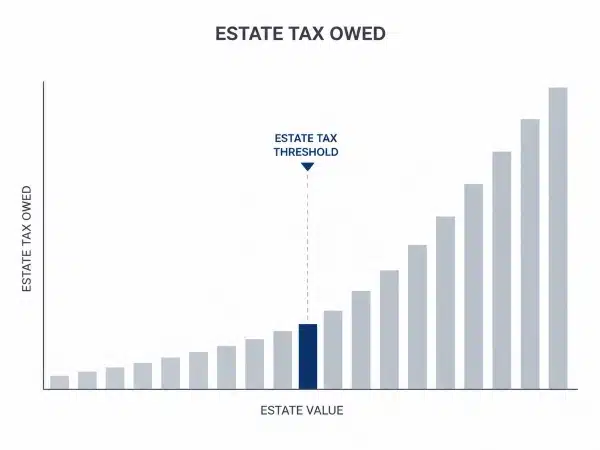
This is the part that catches New Yorkers off guard. The federal exemption is $15 million, but New York’s estate tax is far lower: $7,350,000 for deaths in 2026. And New York has a cliff. Go more than 5% over that line, past $7,717,500, and you lose the exemption entirely. The whole estate gets taxed from the first dollar, not just the amount above the threshold.
The jump is brutal. Below the line, an estate owes nothing. Cross it, and New York taxes the entire estate, not just the amount over the threshold, at rates that climb from 3.06% up to 16%. Going over by a little can cost far more than the amount that pushed the estate across.
There’s a reason this hits NYC families harder than most. A paid-off brownstone, a co-op, and a retirement account add up fast in this city. You don’t have to feel wealthy to land near New York’s threshold, and once real estate is the biggest piece of the estate, the appraised value of that property decides which side of the cliff you’re on. New York also doesn’t allow portability between spouses the way the federal system does, and the return is due nine months after death. That deadline is exactly why getting the valuation done early matters.
Federal vs. New York estate tax, 2026
| Federal | New York | |
|---|---|---|
| Exemption (2026) | $15 million per person | $7,350,000 per person |
| Top tax rate | 40% | 16% |
| Portability between spouses | Yes | No |
| The cliff | None | Yes. Above $7,717,500 the whole estate is taxed |
| Return | Form 706 | Form ET-706 |
| Deadline | 9 months after death | 9 months after death |

Do you still need an appraisal if you’re not selling?
Yes, usually. Even if the home stays in the family, the date of death appraisal sets the stepped-up basis, and that number decides how much capital gains tax an heir pays whenever they do sell.
The mechanic is what makes this matter. The stepped-up basis resets to the property’s fair market value on the date of death. So when an heir sells later, they owe capital gains tax only on the increase since that date, not on the decades of appreciation the original owner built up. Take a Park Slope brownstone bought long ago and held until death: without an appraisal fixing its value on the date of death, the heir has no clean number to anchor that basis, and the IRS can challenge whatever figure they land on years after the fact.
There are other reasons too. The appraisal protects heirs if the estate is ever audited. It keeps things fair when one heir keeps the property and the others take different assets. Attorneys and CPAs often require it. And the consistent basis reporting rules finalized in 2024 now require estates that file Form 706 to report basis figures to beneficiaries, tying the heir’s basis directly to the value the estate reported.
And no, you can’t just use the NYC property tax assessed value or an automated home-value estimate. New York City’s assessed values are capped and lag the market badly, so they rarely match true fair market value, and an online estimate isn’t defensible either. The IRS wants a credible figure, and a screenshot isn’t that. It helps to understand how an appraised value differs from a market estimate before you lean on the wrong one.
Why a date of death appraisal still matters years later
Skipping the appraisal doesn’t make the problem disappear. It just moves it to the worst possible time, years later, when the property sells and someone has to prove what it was worth on a date long past.
Miss it, and the fallout tends to look like this:
- The wrong capital gains tax when the home finally sells
- IRS disputes from missing documentation
- Delays closing the estate or transferring title
- Heirs paying more tax than they had to
Reconstructing a value after the fact is harder and pricier. Sales from five years ago don’t sit on the surface. The appraiser has to dig, and a thin paper trail is easier for the IRS to question. The cheapest, strongest version of this report is the one done close to the date of death, while the market record is still fresh. In the estate files we see, the regret is almost always the same: nobody got the appraisal when it would have been simple, and now it’s a scramble. It’s routine work, and the estate appraisals in Brooklyn and Manhattan we handle are usually ordered by the estate’s attorney or CPA.

The bottom line for New York estates
If you take one thing from this, take this: get the date of death appraisal early, and don’t lose sleep over the alternate valuation date unless an estate attorney tells you the estate is taxable and values fell. For nearly every New York estate, the date of death value is the figure that matters, and documenting it now costs far less than rebuilding it later.
Appraisers stay in their lane, and the sharp firms apply that logic everywhere. If you’re working through an estate in the five boroughs and need a date of death appraisal you can hand it to an attorney or the IRS, talk to a local certified appraiser before the deadline clock runs down.
FAQs
Is a date of death appraisal required in New York if no estate tax is due?
Not for transferring title in most cases, but it’s strongly recommended. The appraisal sets the stepped-up basis heirs inherit, and without it they can struggle to prove the property’s value if they sell or if the IRS asks. New York’s estate tax starts at $7,350,000 for 2026, but basis matters even for far smaller estates.
How does the alternate valuation date affect the step-up in basis?
If an estate elects the alternate valuation date, the heir’s basis becomes the value six months after death instead of the date of death value. When that figure is lower, it can mean a bigger capital gains bill later if the property rises in value. That trade-off is one reason the election only makes sense for estates the move actually helps on tax.
What happens if an inherited NYC property is sold within six months of death?
If the estate elected the alternate valuation date and the property is sold, distributed, or otherwise disposed of within the six-month window, it’s valued as of that transaction date, not the six-month mark. The estate has to document the sale. This rule stops an estate from claiming a lower paper value for a property it already cashed out.
Can I use the NYC property tax assessed value or an online estimate instead of an appraisal?
Generally no, not for tax or legal purposes. New York City assessed values are capped and lag the market, so they rarely match true fair market value, and online estimates aren’t defensible. The IRS expects a credible appraisal, especially under the consistent basis reporting rules that now tie an heir’s basis to the value the estate reports.
What affects the cost of a date of death appraisal in NYC?
Cost tracks the scope of the work. A standard condo or one-to-four family home is simpler, while co-ops, brownstones, and multi-unit properties take more analysis. The biggest factor is how far back the date of death falls, since a date several years ago means reconstructing old sales and market conditions, which takes longer. Set against the capital gains or estate tax a solid appraisal can prevent, it’s a small cost.
Does the alternate valuation date help most New York estates?
Usually not. The alternate valuation date only lowers taxes when values fall in the six months after death, and New York City home prices rose about 5% in 2025 per the Case-Shiller index. In a rising market, the date of death value is typically the lower of the two, so there’s nothing to gain from the election.
What’s the deadline to get a date of death appraisal for a New York estate?
New York’s estate tax return, Form ET-706, is due nine months after the date of death, and the federal Form 706 follows the same timeline. You’ll want the appraisal in hand well before then. An appraisal can still be done years later if one was missed, but it’s harder and easier for the IRS to question.
[hfcm id=”151″]