

A before and after appraisal in NYC for litigation is one property, two effective dates, and one number that matters: the difference between them. One value opinion is dated just before an event. The other is dated after it. The event is usually the excavation next door, a fire or a water loss, a partial taking by an agency, or, in a divorce, the day you got married.
Most owners assume they have already lost, because nobody appraised the property before the damage happened. You have not. Both halves get built after the fact, from data that existed on each date. What decides your case is whether the two dates fit the claim you are making, whether the evidence behind the earlier date still exists, and whether the report lands inside New York’s deadlines. Two of those deadlines are shorter than owners expect.

What Is A Before And After Appraisal In NYC?
A before and after appraisal is a pair of value opinions on one property, each with its own effective date: one immediately before a loss, taking, or legal cutoff, and one immediately after. New York courts use the difference between the two as the measure of damage, or as the share of value subject to division.
Both halves are retrospective, and both are prepared under USPAP. The date that matters is the effective date, not the date I sign the report. The Appraisal Foundation, which writes USPAP, treats those as two separate dates, and a report has to state both. So an appraisal signed in August 2026 can carry an effective date of March 2019, as long as it relies on what a buyer and seller could have known in March 2019. That is the same discipline behind valuing a property as of a past date for probate or a tax basis question. The difference in litigation is that somebody on the other side is paid to attack both dates.
One more distinction, because it costs owners money every year. A cost estimate is not a value opinion. Your contractor prices work. I measure what the market would pay, on a stated date, for the property in the condition it was in. Those two numbers answer different questions, and in New York only one of them can be the ceiling on what you recover.
Three NYC Cases That Need A Before And After Appraisal
Three fact patterns cover almost all of the before and after work that comes through my office in the five boroughs: physical damage, a partial taking, and separate property appreciation in a divorce. Each one pairs a different set of dates, and picking the wrong pair is a faster way to lose than picking the wrong appraiser.
| The case | The “before” date | The “after” date | What the court measures | The deadline that bites |
| Damage: excavation next door, fire, water loss, water main break | The day before the event | After damage is documented, before repairs are made | The lesser of the drop in market value or the reasonable cost of repairs | 90 days to serve a notice of claim if a City agency is involved |
| Partial taking or easement (condemnation) | Value of the whole parcel before the taking | Value of the remainder after the taking | The difference, including consequential damage to what is left | Appraisal reports filed within nine months in Supreme Court condemnation proceedings |
| Divorce: appreciation of separate property | Date of marriage, or the date you acquired the asset | The valuation date the judge sets, anywhere from commencement to trial | How much of the increase traces to the other spouse’s contributions or efforts | Whatever date the court picks, which can move |
Damage From The Building Going Up Next Door
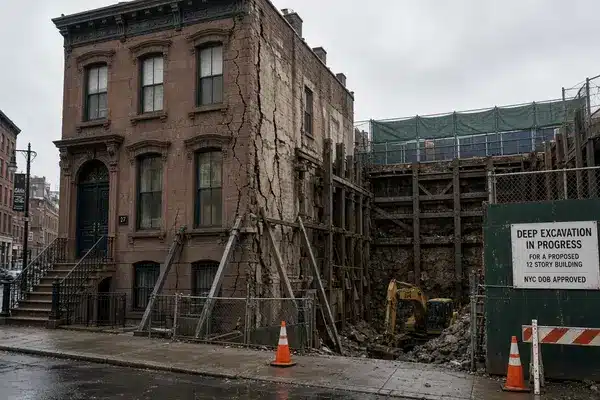
This is the NYC version of the claim, and it is the one I get called about most. A developer buys the lot beside your brownstone, digs, underpins, and your party wall opens up. Or a City water main lets go and the cellar floods.
The city’s own numbers show how routine the second version is. In the New York City Comptroller’s annual claims report for fiscal 2023, owners filed 5,267 property damage claims against the City, and the City paid $6.3 million to settle property damage claims that year, down from $7.8 million the year before. Property damage came to about 1 percent of all tort payouts. Read that gap honestly: thousands of claims, a small pool of money. The claims that get paid are the documented ones.
Private construction damage runs on a different track. Before a developer digs next to you, the city’s excavation rules require their engineer to survey the condition of your building first. Building Code section 3309 then requires monitoring during the work whenever your building sits within a distance equal to the depth of the excavation. Historic buildings within 90 feet get monitored too. Those documents are useful to me. They are also the reason many owners think they are covered when they are not, which I get to below.
Partial Takings And Easements
When an agency takes part of your parcel, or runs an easement through it, New York does not value the strip in isolation. Damages are measured by the difference between the fair market value of the whole before the taking and the fair market value of the remainder after the taking. The Court of Appeals set that out in Acme Theatres v. State of New York in 1970, and the Appellate Division applied the same formula in Rose Park Place v. State of New York in 2014.
Just compensation is not limited to the strip that was taken. It also covers consequential damage to the part you keep. In Lerner Pavlick Realty v. State of New York, the Appellate Division put the burden on the claimant to prove those indirect damages and to give the court a basis for estimating them. That burden is the whole reason the “after” half of the appraisal has to be built with the same rigor as the “before” half. An owner who proves the taking but shrugs at the remainder leaves money on the table.
Divorce And The Appreciation Question
In a New York divorce, the increase in value of separate property is separate property, “except to the extent that such appreciation is due in part to the contributions or efforts of the other spouse.” That clause sits in Domestic Relations Law section 236(B)(1)(d)(3), and it is a before and after question wearing different clothes. Somebody has to value the apartment as of the date of marriage, and again as of the date the court chooses.
That second date is not fixed. Under section 236(B)(4)(b), the court sets the valuation date for each asset, and it “may be anytime from the date of commencement of the action to the date of trial.” In a market that moved as much as NYC’s did between 2020 and 2024, the choice of date can be worth more than the argument about contributions. Attorneys who order divorce appraisals early usually get to argue for the date, instead of inheriting one.
Why Does The “After” Number Cap What You Can Recover?
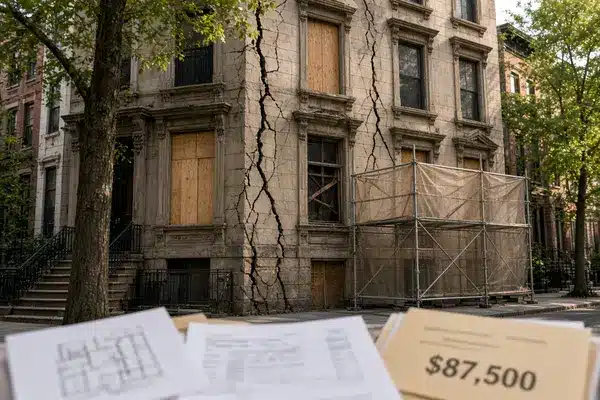
Because New York caps property damage at the smaller of two measures, and your repair invoice is one of them. The Court of Appeals held in Fisher v. Qualico Contracting Corp. that a property loss is measured by “the difference between [the property’s] market value immediately before and immediately after it was damaged, or the reasonable cost of repairs necessary to restore it to its former condition, whichever is less.”
Sit with that for a second. If your building lost $400,000 in market value and the repair bill is $90,000, you are arguing about $90,000. If the value drop is $90,000 and the repair bill is $400,000, you are still arguing about $90,000. Neither number is safe to assume. You need both, measured properly, before you decide what your claim is worth.
There is a wrinkle in your favor. Under Jenkins v. Etlinger, decided by the Court of Appeals in 1982, a party claiming injury to real property has to establish damages under only one measure, even when others could apply. The other side may then put in evidence that a smaller amount is enough. So you carry one number well, and they carry the burden of arguing the cheaper one.
Which brings me to the advice most owners hear too late: get the valuation done before the repair, or at minimum before the evidence disappears. Once the crack is patched and the invoice is paid, the cheapest number in the file is the invoice, and the other side will hand it to the judge. This is also why a replacement cost appraisal and a before and after appraisal are not interchangeable. One prices reconstruction. The other measures loss.
Your Neighbor’s Preconstruction Survey Is Not A Before Appraisal
The survey documents the condition. It says nothing about value, and that is the single most common misread I see in NYC damage claims.
The survey has a narrow job. Your neighbor’s engineer walks your building before excavation, photographs existing cracks, notes settlement, and files a preconstruction report summarizing the condition of the structure. The monitoring plan tracks movement during the dig. Both are required work, and both help me, because they timestamp your building’s condition on a date you can then use as a “before” effective date with real evidence behind it.
What they do not contain: a market value, a comparable sale, a rent roll, a share allocation, a land lease term, or a dollar figure of any kind about your apartment or your building. An engineer’s condition report and a certified appraiser’s value opinion are not substitutes, and no judge treats them as such. Owners who rely on the survey alone show up with proof that something changed physically and no proof of what it cost them.
Do this instead. When you get notice that a neighbor is filing for excavation, order the “before” half then, while the building is intact and the data is current. It is the cheapest appraisal in the whole sequence, because nothing has to be reconstructed.
What Are The 2026 Deadlines That Decide Whether Your Appraisal Gets Used?
Two deadlines do most of the damage, and both of them run faster than the appraisal itself.
If a City agency caused the loss, General Municipal Law section 50-e requires you to serve a notice of claim within 90 days after the claim arises, and that notice has to itemize the damages you are claiming. A judge can grant leave to file late, but the same statute caps any extension at the time limit for starting the lawsuit itself, so late filing is a motion, not a plan. Ninety days is not long enough to reconstruct a value history from scratch while also arguing with a claims adjuster. Start the appraisal in week one.
In condemnation proceedings in the Supreme Court, the court’s rule on appraisal reports gives each side nine months after service of the claim, demand, or notice of appearance to file its appraisal report, with rebuttal reports due within 60 days of receiving the report they answer. The consequence for missing it is written into the rule: a party who fails to file “shall be precluded from offering any appraisal testimony on value.” A late report is not a weak report. There is no report.
Two more dates worth calendaring. In divorce, the valuation date is the court’s to set anywhere between commencement and trial, so the sooner your side has a value, the sooner your side can argue for a date. And in any New York case where your appraiser will testify, CPLR 3101(d) requires each side, on request, to disclose the substance of the facts and opinions its expert will give, which means the report needs to be finished and defensible well before anybody is sworn in.
How I Build The Two Halves So They Hold Up
I build the “after” value the way I build any NYC appraisal, then I rebuild the market backwards to the earlier effective date using only what existed then.
Reconstructing the earlier date means pulling archived listing photos and price history, ACRIS deeds and mortgages, DOB job filings and complaints on both your building and the neighbor’s, 311 records, and the monitoring reports the neighbor’s engineer already filed. For a co-op or condo I also want the board minutes, the building’s financials, the underlying mortgage, and the share allocation. Co-ops are where out of area appraisers get this wrong most often, because share allocation and a land lease term can move value more than the unit’s condition does.
Two habits matter more than the software. First, I measure rather than trust the record, because public records and actual square footage disagree constantly in this city, and a gross living area error is the easiest thing for opposing counsel to find. Second, every adjustment in the “before” half has to be supported by a sale that closed before the effective date. A comparable that closed a month after the loss is an invitation to be cross-examined on hindsight.
I have been appraising NYC property since 2007, and I grew up around this work: my mother sold real estate and my father was a broker and a certified appraiser. That matters here for a plain reason. Reconstructing a Bensonhurst or Clinton Hill block as it was six years ago is a memory problem as much as a data problem, and I remember those blocks.

What To Collect Before You Call An Appraiser
Bring the paper that fixes dates, because dates are what I have to defend. Photographs with intact metadata are worth more than a written description of what the wall looked like.
The short list: dated photos and video from before and after, the neighbor’s DOB job number, any 311 or DOB complaint numbers, the engineer’s preconstruction survey and monitoring reports, and your insurance claim file with any adjuster reports. Add repair estimates and invoices, leases or a rent roll if units are rented, and for a co-op or condo the offering plan, recent financials, and board minutes covering the period. If you have a prior appraisal of the property, tell your attorney before you send it to anyone, including me. It may be discoverable.
Property owners who arrive with that file get a defensible “before” date. Owners who arrive with a repair invoice and a story get a fight.
What A Before And After Appraisal Costs In Nyc And How Long It Takes
A before and after appraisal costs more than a standard mortgage appraisal because it is two value opinions, not one, and one of them has to be rebuilt from historical data.
Three things move the fee: how far back the earlier effective date sits, whether the property is a co-op (share allocation and building financials add research), and whether the assignment includes deposition or hearing support. Ask for the fee in writing, and ask whether testimony is included or billed separately. An appraiser who cannot answer that in one email is not ready for your case.
Getting The Two Dates Right Is The Whole Job
If your property lost value because of something someone else did, the before and after appraisal in NYC for litigation is the document that turns that into a number a court can use. The subtraction is simple. Choosing dates that match your claim, preserving the evidence behind the earlier one, and filing inside the 90 day and nine month windows is the work.
I prepare these reports for owners and for attorneys across Manhattan, Brooklyn, Queens, the Bronx, and Staten Island, and I hold a 5.0 rating across more than 170 Google reviews from clients in neighborhoods like Clinton Hill, Murray Hill, and Flushing. See how appraisals prepared for court sit alongside the estate and date of death work that runs on the same retrospective method.
If you need a before and after appraisal in NYC for litigation, whether it is a damage claim, a partial taking, or a divorce where the date of marriage value is in dispute, tell me the dates you need. I will tell you what evidence still exists to support them, and what it will take to defend both halves.
FAQs
What is a before and after appraisal in NYC for litigation?
It is two value opinions on the same property with two different effective dates, one before an event and one after it, prepared so the difference can be used as evidence. New York courts use that difference to measure damage to real property, compensation in a partial taking, or the appreciation of separate property in a divorce. Both halves are retrospective and both are prepared under USPAP.
Can an appraiser value my property as of a date in the past?
Yes. USPAP separates the effective date of the value opinion from the date the report is signed, so an appraisal completed today can carry an effective date years earlier. The appraiser has to rely only on data that existed as of that effective date, which is why comparable sales that closed after the event get challenged in court.
How does New York measure damage to real property?
New York uses the lesser of two measures: the difference in market value immediately before and immediately after the damage, or the reasonable cost of repairs needed to restore the property. The Court of Appeals stated it that way in Fisher v. Qualico Contracting Corp. in 2002. Under Jenkins v. Etlinger, you only have to prove one measure, and the other side carries the burden of showing a smaller amount is enough.
How long do I have to file a claim if the City damaged my property?
General Municipal Law section 50-e requires a notice of claim within 90 days after the claim arises, and the notice has to itemize the damages you are claiming. In fiscal 2023, owners filed 5,267 property damage claims against New York City, and the City paid $6.3 million settling property damage claims that year. Start the valuation work in the first week, not the twelfth.
When does an appraisal report have to be filed in a condemnation case?
In Supreme Court condemnation proceedings, 22 NYCRR 202.61 requires each side to file its appraisal report within nine months after service of the claim, demand, or notice of appearance, with rebuttal reports due within 60 days. A party who fails to file is precluded from offering any appraisal testimony on value, so a missed deadline removes your valuation evidence entirely.
Is my neighbor’s preconstruction survey the same as a before and after appraisal?
No. The engineer’s preconstruction survey documents the physical condition of your building before excavation, which the city’s excavation rules require, along with monitoring during the work under Building Code section 3309. It contains no market value, no comparable sales, and no dollar figure. It is useful evidence of condition on a date, and it is not a substitute for a certified appraisal.
What date does a New York court use to value a house in a divorce?
The court sets it. Domestic Relations Law section 236(B)(4)(b) says the valuation date for each asset may be anytime from the date of commencement of the action to the date of trial. For separate property that appreciated, you also need a value as of the date of marriage, because only the appreciation tied to the other spouse’s contributions or efforts is subject to division.
[hfcm id=”156″]