

ANSI Z765 gross living area is the finished, above-grade space in your home measured from the exterior walls. Under ANSI Z765-2021, a room only counts as GLA if it checks every item on a strict list. Miss one, and that square footage drops off the appraisal report entirely.
ANSI Z765 gross living area includes only heated, finished, above-grade residential space with permanent heating systems, standard interior surfaces, minimum 7-foot ceilings, and direct interior access from the main living area. Below-grade space is always reported separately, regardless of finish quality.
Most homeowners discover a smaller-than-expected GLA when the appraisal comes back. Discrepancies often range from 50 to 300 square feet. At $10–$15 per square foot, these gaps can reduce the final value by $500–$4,500.

What Qualifies as ANSI Z765 Gross Living Area?
Any space must meet six criteria to count. The room needs standard finished materials such as drywall, carpet, hardwood, or equivalent ceiling and flooring. It has to sit entirely above grade. Even two feet below ground level pushes the entire room into the basement category on the report.
A space must have permanent, built-in heating. Forced air, radiant, solar, and ductless systems all qualify, while portable space heaters do not. At least 50% of the finished area must have ceilings that reach 7 feet or higher. In rooms with sloped ceilings, such as finished attics, you must exclude any portion under 5 feet from the total. The space must connect to the rest of the home through a finished, heated hallway or stairway. Your local building department must also issue a permit for the space.
So what doesn’t count? Garages, unfinished basements, enclosed porches without permanent heat, detached guest houses, and unpermitted additions. These get reported separately or folded into the total living area, but they never show up in GLA.
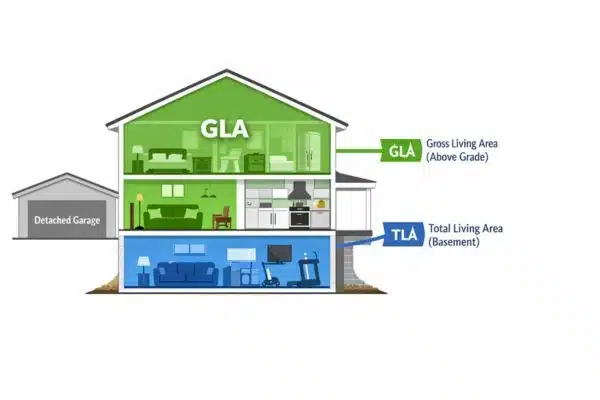
How Is Gross Living Area Different From Total Living Area?
GLA captures above-grade finished space only. Total living area (TLA) picks up everything else that’s finished and livable, including basements and accessory dwelling units. Appraisers keep these numbers separate because a finished basement doesn’t command the same price per square foot as above-grade rooms in most markets. Mixing them would skew the comparable sales data and produce unreliable value opinions.
The U.S. Census Bureau reported that the median new single-family home completed in 2024 measures 2,146 square feet of above-grade space. That benchmark only works when appraisers measure GLA consistently, and ANSI Z765 enforces that consistency.
One big change to know about: Fannie Mae’s June 2025 Selling Guide update (SEL-2025-04) officially retired the term “gross living area” on appraisal forms. The new UAD 3.6 reports use “above-grade finished area” instead. Same measurement rules, new label. Mandatory compliance kicks in November 2, 2026.

How Do Appraisers Measure Gross Living Area?
Appraisers measure detached single-family homes along the exterior perimeter walls. For condos and attached units, they measure from the interior walls because shared walls make exterior measurement impractical. In dense markets, buyers often confuse this distinction because listing agents sometimes advertise gross square footage that includes common areas instead of the appraiser’s ANSI-compliant GLA figure, even when home measurement services are used.
The process starts at one corner. The appraiser works around the structure, recording each wall to the nearest inch or tenth of a foot. Those measurements feed into sketch software that calculates total square footage. ANSI Z765 now requires computer-generated sketches showing all calculations. Hand-drawn diagrams don’t cut it for GSE-backed loans anymore, which is why many professionals rely on home measurement services for accuracy and compliance.
Variations under 100 square feet between two appraisals of the same home are normal. Differences beyond that usually indicate a measurement error or a disagreement about whether a specific space qualifies.

Why Does Your Home’s GLA Accuracy Matter in 2026?
Real estate agents pull square footage from tax records when listing homes. Those numbers are frequently wrong. Tax assessors don’t follow ANSI Z765, and most MLS entries don’t either. I’ve reviewed appraisal reports where the GLA came back 200 square feet below the listing. At $15 per square foot, that adjustment cuts $3,000 from the appraised value. Deals fall apart over less.
A national home appraisal runs $314–$424 on average (Angi, March 2026). In New York, expect closer to $625 for a single-family home or condo, especially for residential appraisals in NYC. If the listed square footage looks suspiciously round or unusually generous, get an ANSI-compliant measurement early to avoid surprises at closing.
Every buyer and seller should ask their appraiser: “Do you use a computer-generated GLA sketch that follows ANSI Z765 and shows all calculations?” If they don’t answer yes, treat it as a red flag.
Block Appraisals provides ANSI Z765 gross living area measurements and full residential appraisal services across NYC. When your property’s reported square footage doesn’t match what a qualified appraisal professional measures on-site, knowing the accurate number before listing or closing protects both your deal and your negotiating position.
Frequently Asked Questions
Does ANSI Z765 gross living area include finished basements?
No. ANSI Z765-2021 classifies any space that sits partially or fully below grade as a basement, even if it has full finishes like drywall, flooring, and permanent heating. Appraisers report finished basements separately as “below-grade finished area” on the appraisal form. These spaces can still add value to the home, but appraisers track that value in a different line item than GLA.
Why does my appraisal GLA differ from the MLS listing or tax records?
MLS listings and tax assessor records often include non-GLA space like garages, enclosed porches, or below-grade rooms. Tax assessors and real estate agents don’t follow ANSI Z765 measurement standards. Appraisers do. Discrepancies of 50 to 300 square feet are common, and at typical market adjustments of $10–$15 per square foot, those gaps can shift appraised value by $500–$4,500.
What ceiling height does ANSI Z765 require for gross living area?
The standard requires at least 7 feet of ceiling height across more than 50% of the finished room’s floor area. For rooms with sloped ceilings (like finished attics), any portion with less than a 5-foot ceiling must be excluded from the GLA calculation entirely.
Do stairs count toward gross living area?
Yes. Stairs are included in the GLA calculation and counted on the floor from which they descend. So a stairway from the first floor to the second floor adds that square footage to the first floor’s GLA total, per Fannie Mae’s property measuring guidelines (April 2025).
How does UAD 3.6 change GLA reporting in 2026?
Fannie Mae’s UAD 3.6 reporting framework replaces “gross living area” with “above-grade finished area” and requires a more detailed level-by-level breakdown of finished space. The new forms entered broad availability on January 26, 2026, and become mandatory for all GSE-backed loans on November 2, 2026. The underlying ANSI Z765 measurement rules haven’t changed.
Is gross living area measured differently for condos than houses?
Yes. Single-family detached homes are measured by exterior perimeter walls. Condos and attached units use interior perimeter measurements because shared walls make exterior measurement impractical. In New York City specifically, listing agents often cite gross square footage (GSF) or net square footage (NSF), neither of which matches the appraiser’s ANSI-compliant GLA figure.
Can I challenge an appraiser’s GLA measurement?
You can. Request the computer-generated sketch showing all measurements and calculations. If you find a discrepancy greater than 50–100 square feet compared to a prior appraisal or your own measurements, you can request a re-measure with supporting documentation. Appraisers are required to provide ANSI Z765-compliant sketches, so you have a clear reference point for comparison.
[hfcm id=”146″]