
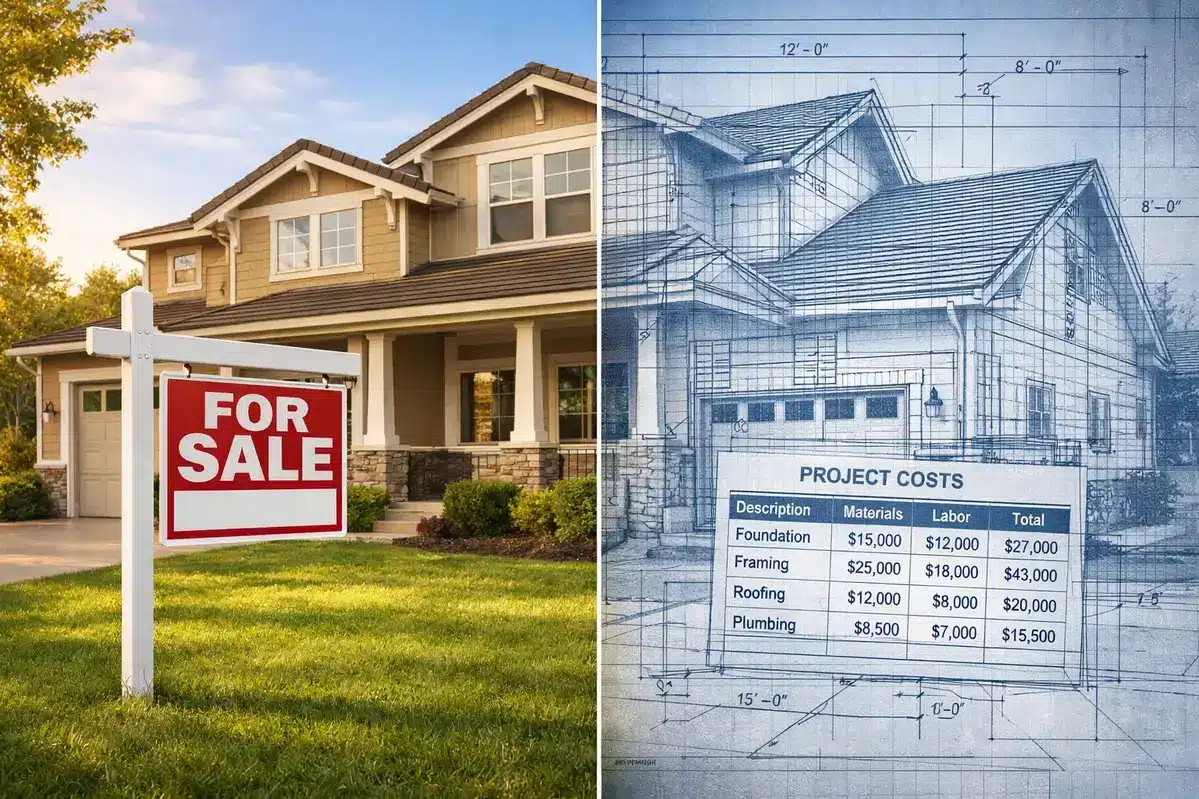
Your home’s appraised value and its replacement cost are two completely different numbers. Confusing them is the most common reason homeowners end up underinsured after a fire, flood, or storm. The appraised value is what the market would pay for your property today, land included. Replacement cost is what it would take to rebuild the physical structure from scratch using today’s labor rates, materials, and building codes.
According to the NAHB’s 2024 Construction Cost Survey, average construction costs for a single-family home hit $162 per square foot in 2024, the highest in the survey’s history. For an average 2,647-square-foot home, that’s $428,215 in build costs alone.
The difference between appraised value and replacement cost comes down to what each figure measures. Appraised value reflects market conditions, land, location, and comparable sales. Replacement cost reflects only what it costs to rebuild the structure today, using current labor, materials, and code-compliant construction. These two numbers often differ by tens of thousands of dollars.
Why Do These Two Numbers Diverge So Much?
An appraisal answers a market question. How appraisers estimate value involves comparable sales, neighborhood demand, and the lot itself. In coastal markets, land alone can represent 30–50% of the appraised price. That land doesn’t need to be rebuilt after a disaster. For a deeper look at how these figures interact, the difference between appraisal value and market value is worth understanding before your next policy renewal.
Replacement cost ignores the land entirely. It asks one question: what would it cost to restore this building to the same size and quality, up to today’s code requirements?
Two entirely different questions. Two very different answers.
Appraised Value vs. Replacement Cost at a Glance
| Factor | Appraised Value | Replacement Cost |
| Includes land | Yes | No |
| Based on market conditions | Yes | No |
| Reflects build costs | No | Yes |
| Primary use | Buying, selling, lending | Insurance coverage |
| Moves with real estate market | Yes | Tied to labor & materials |
| Avg. 2024 national figure | $665,298 avg. sales price (NAHB) | $428,215 construction only (NAHB) |
What Makes Replacement Cost Higher Than Homeowners Expect?
Three things push every rebuild above what most people anticipate: labor shortages, mandatory code upgrades, and energy compliance costs.
Skilled trade shortages drove rebuild costs higher: the Harvard Joint Center for Housing Studies reported that 59% of remodelers faced skilled-trade shortages in 2023. Add mandatory code upgrades — a rebuild must meet today’s requirements, not those from when the home was first built — and 2024 IECC energy efficiency compliance, and the gap between what homeowners expect and what a rebuild actually costs widens fast.
These factors explain why new-home sales data from the U.S. Census Bureau and NAHB construction cost figures don’t track together. The national median new-home sales price was $414,000 in December 2025. Average construction-only costs for a comparable structure ran $428,215 — because sales price includes land and other factors, while construction cost strips them out.
Should You Insure for Appraised Value or Replacement Cost?
Replacement cost. Every time.
Your insurer pays to rebuild what was destroyed, not to replace your asset on the open market. A policy pegged to market value in a high-land-value area leaves your structural coverage short. The North Carolina Department of Insurance draws this distinction clearly: actual cash value policies factor in depreciation, while replacement cost coverage restores your home at today’s prices.
I’ve seen homeowners with $650,000 market-value policies face rebuild estimates of $800,000 or more. That $150,000 gap comes straight out of pocket.
How Often Should You Update Your Replacement Cost Estimate?
Every year. After major renovations, right away.
The JCHS found homeowners insurance premiums rose 17% nationally from 2021 to 2023, partly because replacement costs outpaced policy limits across millions of homes. A kitchen remodel or a bathroom addition changes your rebuild figure — and research confirms that home renovations increase appraisal values in ways that also shift your replacement cost upward. For a documented number that holds up in a claim, getting a professional replacement cost appraisal is far more reliable than any online calculator.
Block Appraisals connects with homeowners through local search, working alongside a team with deep local SEO expertise to put certified appraisers in front of the people who need them.
Three questions worth asking your insurance agent: which replacement cost estimator did they use, which version, and when was it last updated. Those questions save homeowners serious money.
FAQs
Does my home appraisal include replacement cost for insurance?
No. A real estate appraisal reflects market value, including land and comparable sales. Insurance companies use separate replacement cost estimators, such as Marshall & Swift or CoreLogic tools, to calculate rebuild costs. Using the appraised figure as your coverage baseline can leave you tens of thousands short. The NAHB’s 2024 data shows an average gap of roughly $237,000 between construction-only costs and total home sales price, largely because land accounts for 13.7% of the average new home’s price.
Why is replacement cost sometimes higher than what I paid for my house?
Construction costs rise on their own timeline, separate from what you paid. Labor shortages, material inflation, and mandatory code upgrades all push rebuild costs up over time. In 2024, the NAHB reported that construction costs represented 64.4% of a new home’s final sales price, the highest percentage ever recorded. What you paid years ago doesn’t reflect today’s build rates.
How often should I update my home’s replacement cost estimate?
At minimum, once a year. After any major renovation, immediately. The Harvard Joint Center for Housing Studies found that homeowners insurance premiums rose 17% from 2021 to 2023, partly because outdated replacement cost figures left millions of homeowners underinsured. Most carriers recommend reviewing coverage every two to three years at minimum, though annual reviews are safer.
Can I insure my home based on its appraised value instead of replacement cost?
You can, but doing so almost always creates a coverage gap after a total loss. Market value includes land, which doesn’t need to be rebuilt. In high-land-value coastal markets, insuring based on appraised value can leave you hundreds of thousands short of what a rebuild actually costs. The NAIC advises homeowners to confirm with their agent that their policy reflects true replacement cost, not market value.
Does replacement cost coverage include my land or yard?
No. Replacement cost strictly covers rebuilding the home’s physical structure. Land, landscaping, driveways, and outbuildings are separate considerations and typically require additional coverage or a separate rider. If your policy doesn’t address these, it’s worth confirming exactly what is covered with your agent.
How do regional differences affect appraised value versus replacement cost?
The gap varies significantly by market. In coastal Northeast and Pacific regions, land accounts for a much larger share of appraised value, making replacement cost proportionally lower than the total property price. In rural inland markets, the opposite can be true: construction costs sometimes exceed what the property would fetch on the open market. NAHB regional data shows construction costs ranging from roughly $133 per square foot in East South Central markets to over $282 per square foot in New England.
Are online replacement cost calculators accurate enough to rely on?
For standard builds, they’re a reasonable starting point. But they frequently fall short for older homes, homes with custom features, or properties in markets with significant local labor premiums. Tools like Marshall & Swift and CoreLogic provide better baselines than generic online calculators, but even those may not capture recent local contractor markup or code-mandated upgrades. For homes with significant custom work, a professional assessment is more reliable.

